

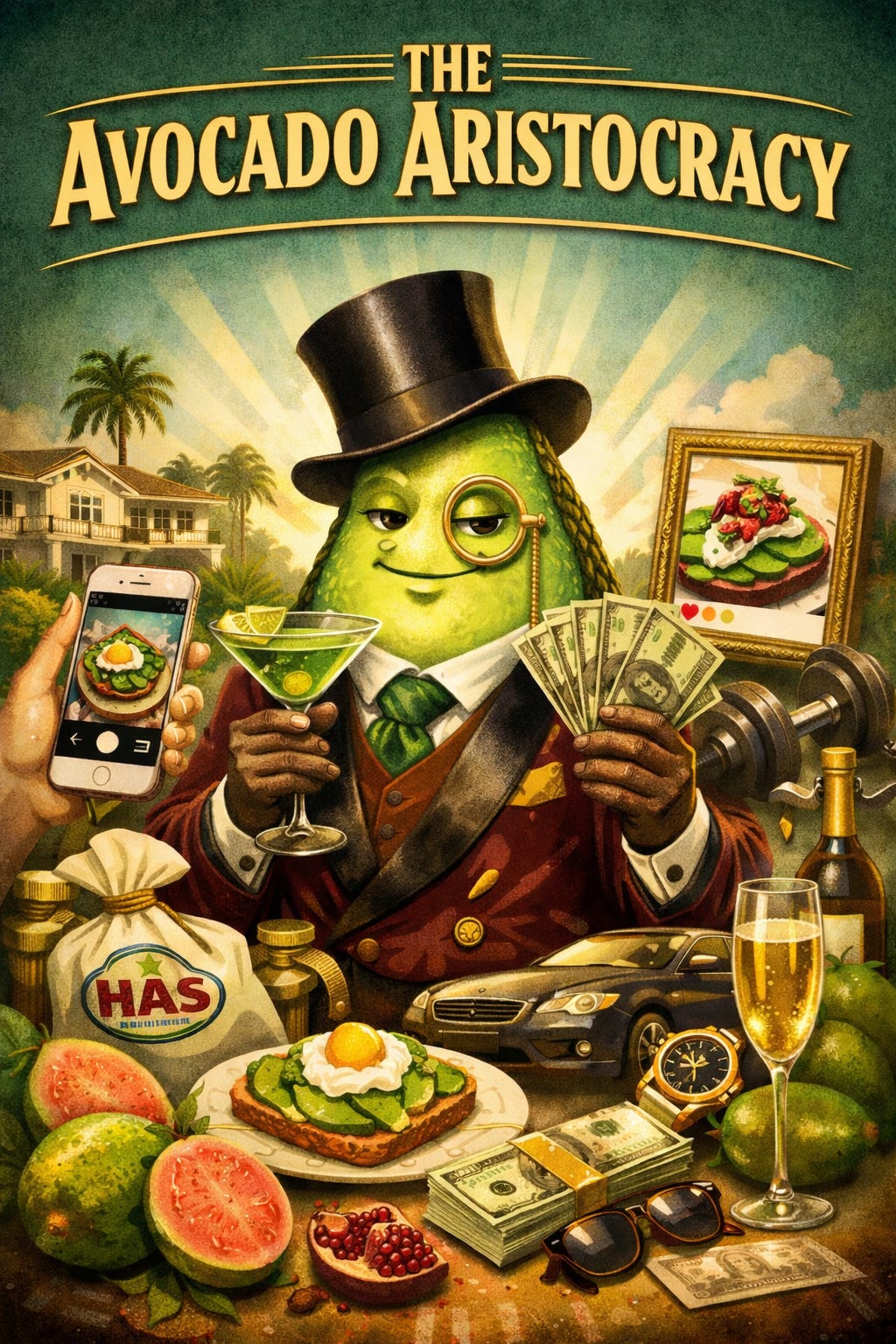
Somewhere right now, a person with a very clean kitchen and a very curated Instagram feed is slicing open an avocado, arranging it in a fan shape on a piece of sourdough bread that costs more than a small car, drizzling it with olive oil that has a backstory, sprinkling it with pink Himalayan salt, because regular salt is for people who haven’t found themselves yet, and photographing it from four angles before eating it cold, alone, and deeply satisfied that the world now knows they are the kind of person who eats avocado.
That person is not eating breakfast. That person is filing a press release.
Welcome to the age of the avocado, a lumpy, brown-on-the-outside, goes from concrete-to-compost in forty eight hours fruit that has somehow convinced the entire world that it is both a superfood and a lifestyle. A fruit so aggressively over-marketed, so relentlessly positioned, and so perfectly timed to arrive at the exact moment that social media turned eating into a competitive sport, that we now spend billions, with a B, as in billions of dollars that could fund actual healthcare, on it every single year, while the guava sits three shelves below it in the supermarket, completely ignored, not even getting a nickname.
But let’s begin at the beginning, because the full story of how a Mexican fruit conquered the world’s wallet is too magnificent to rush.
The Fruit That Hired a PR Firm
The avocado did not go viral by accident. It was launched. It was deployed. It was sent into the world with the kind of strategic precision normally associated with military operations and Apple product announcements.
Meet the Hass Avocado Board a.k.a the HAB, a body created by an actual Act of the U.S. government, funded by a tiny assessment charged on every single avocado sold in America. This means that every avocado you have ever purchased has come with an involuntary donation to an organization whose stated mission, written down with a straight face in official documents, is to make avocados “America’s preferred healthy food for every meal.” Not some meals. Not most meals. Every meal. The HAB wants avocado at your 6am overnight oats, your 11am desk snack, your 3pm slump, your dinner, and your 2am fridge raid. The HAB has plans for you, and those plans are green and slightly overpriced.
But the HAB’s real masterstroke wasn’t marketing. It was science.
With characteristic genius, the board established the Avocado Nutrition Center, which has funded over forty clinical studies at top universities generating peer-reviewed research on avocado’s benefits for heart health, diabetes, weight management, gut health, and cognitive function, all of which arrived, with the reliability of a rigged carnival game, at findings that were broadly, consistently, conveniently wonderful for avocados. The research was then packaged into content for doctors, dietitians, and the HAB’s own army of “Avocado Goodness Experts”, a real job title, on real business cards, given to real registered dietitians whose role is to attend conferences and medical grand rounds and explain to physicians the Strategic Health Pillars of avocado consumption, which is a sentence that should not exist in a functioning society but here we are.
Now the sweet potato has never once had a Sweet Potato Goodness Expert present its case at the American Diabetes Association annual conference. The chickpea has no federally-backed research centre. The humble guava has approximately zero clinical trials funded by anyone, because nobody formed the Guava Board, and that oversight is costing guava dearly.
Having bought themselves a body of science, the HAB then executed Phase Two with timing so perfect it feels choreographed: the pivot to social media influencers, arriving at precisely the moment that “health influencer” stopped being a punchline and became an actual W-2 occupation. By 2020 the HAB had launched its own in-house influencer programme. By 2024 it had grown to over forty content creators generating more than two million impressions per month, authentic lifestyle content, they call it ensuring that on any given morning, somewhere between your friend’s travel photos and an ad for a mattress, there is a beautiful person with excellent lighting telling you that avocado has changed their relationship with food. And with themselves. And with the concept of healthy fats. They are glowing. They look expensive. The avocado in their hand looks expensive. Expensive, apparently, is the point.
The whole machine, the federal board, the funded science, the medical ambassadors, the influencer army is not a conspiracy. It is capitalism operating at full voltage pointed at a green fruit.
The Three Types of Avocado People
The modern avocado devotee exists on a spectrum that begins at “perfectly reasonable” and ends somewhere beyond the reach of conventional therapy.
At the sensible end, you have the Casual Consumer, someone who actually likes the taste, buys avocados occasionally, and has never once used the phrase “healthy fats” in a social situation. These people are fine. We leave them in peace.
In the middle sits the Aspirational Eater, the person who doesn’t particularly enjoy avocado, the texture, if we’re honest, is somewhere between flavoured soap and a bad decision but who understands deeply, instinctively, what ordering avocado toast communicates. It communicates disposable income. It communicates intention. It communicates that you are the kind of person who has transcended beige. The Aspirational Eater has never once photographed a bowl of lentils because lentils say nothing socially.
At the far, unreachable end of the spectrum we find the Full Avocado Evangelist: a person with an avocado-themed throw pillow that says “Avo Good Day,” who considers this decorative rather than diagnostic. They have tried avocado in a smoothie, a brownie, a face mask, and a cocktail. Their WiFi is named “GuacAndRoll.” Their highlight reel is titled “Avo Life.” They once cried at a farmers’ market. We wish them well and do not make eye contact.
The Holy Ritual a.k.a. Brunch
You have ordered your avocado toast. The café has tasteful exposed brick, staff with opinions about pour-over ratios, and a menu where everything is described as “seasonal” and “mindful.” Your toast costs $18.
It arrives. You do not eat it. Not yet. First you photograph it. Above. Angled. Filter. The green must be greener. The bread more golden. Caption: “nourishing myself this Sunday 🥑✨ #cleaneating #wellness #avotoast #plantbased #selfcare.” Post. Wait forty-three seconds. Dopamine.
Then you eat it. Cold.
You are not having breakfast. You are producing content with a side of breakfast, and the avocado is not a fruit on your plate — it is a prop in the ongoing theatrical production of your highest self. The audience is 847 followers, most of whom are bots or your aunt Sharon, but the performance must be rendered faithfully regardless. You have communicated that you are healthy, intentional, financially comfortable enough to spend $18 on toast, and located in a neighbourhood with exposed brick. This is a lot to achieve before 11am on a Sunday. The avocado toast has earned its price.
A Brief Word on the Environment That Nobody at the Brunch Table Wants to Have
The avocado is the sacred food of the environmentally conscious, the ones who use a reusable cup, compostable cutlery, the ones who will conduct a small public trial over your plastic straw. These same people are eating a fruit that requires approximately 320 litres of water per specimen to produce, that has driven deforestation across Mexico and Chile, and whose trade in certain Mexican states has become so lucrative that organized crime controls significant portions of it. The environmental footprint of your avocado’s journey from a hillside in Michoacán to the sourdough in your kitchen is, to use the appropriate scientific terminology, absolutely enormous.
The Budget Heresy: For those prepared to betray the faith in exchange for their savings account
Guava: The most underrated fruit in the known universe and the greatest rebuke to the avocado’s mythology. A single cup delivers over 4 grams of protein, making it one of the highest-protein fruits on the planet, along with nearly 9 grams of fibre, and a staggering 376 milligrams of vitamin C, roughly four times the amount in a kiwi, enough to make an orange feel inadequate. It has potassium, antioxidants, and compounds in its leaves studied for antibacterial and anti-diabetic properties. It is extraordinary. It has no Goodness Experts. It has no influencer programme. It has no federal board charging an assessment on every unit sold to fund clinical trials at the University of Texas. It just sits there, on a lower shelf, doing spectacular things for bodies that belong to people who haven’t been marketed at yet. Find it. Eat it.
Bananas: Twenty cents. Highest potassium per calorie of any common fruit. Magnesium, B6, fibre, and the kind of sustained energy that requires no Strategic Health Pillar to explain. Photographs terribly. This is its only flaw and the sole reason it doesn’t have its own influencer programme.
Walnuts: Contain the same unsaturated fatty acids that make avocado famous, plus protein and fibre, at a lesser cost, and with the biological advantage of not turning black and dying of shame if you don’t eat them within two days of purchase.
Chickpeas: Mashed into hummus, these produce a creamy, protein-rich, fibre-dense toast topping for approximately one-eighth of the cost of guacamole, with more protein and iron. The chickpea has no aesthetic. The chickpea is, for this exact reason, profoundly free.
All of these things will do everything the avocado promised but none of them will signal to your colleagues that you have your life together, which is the actual reason you’re spending $6 on a single piece of fruit, and we both know it.
A Closing Prayer for the Dearly Departed Wallet
We are not here to take your avocado. We are not unreasonable.
Eat it sometimes. Enjoy it. Life is genuinely short and guacamole is one of humanity’s better inventions. The avocado is healthy. It is tasty.
But the next time you’re standing in the supermarket holding a $6 avocado, consider this: you are holding the most successfully marketed fruit in modern history, a fruit backed by a federal board, forty clinical studies, a network of medical ambassadors, and an influencer army two million impressions strong, all working, continuously, to ensure you reach precisely this moment and make precisely this choice.
You are not choosing a superfood. You are completing a transaction that an entire industry architected, funded, and seeded through every doctor’s office, wellness podcast, and Instagram scroll between you and this moment.
The guava is three shelves below you. It has none of that. It is just sitting there, quietly containing four times your daily vitamin C and more protein than any fruit has a right to offer, available at a fraction of cost, hoping someone will notice.
One of these choices is nutrition. The other is marketing. The avocado is perfectly lovely. But knowing the difference is the most genuinely healthy thing you can do today.
Avo good day